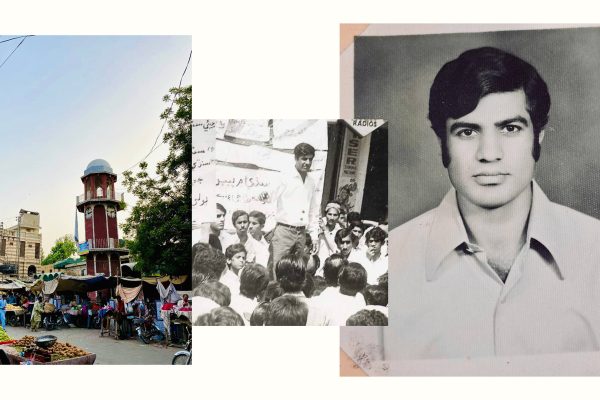
It is the late 60s or early 70s. Pakistan is under the military rule of Yahya Khan and the two geographical wings – East and West – are on their final threads together before their eventual genocidal separation. In a small town in Northern Sindh called Khairpur, a young boy, still dressed in the white-collared shirt and loose dress pants that make up his college uniform, stands on a raised platform, addressing a crowd of men. His parents do not know he is here. He has not even had the chance to wash his face or comb his hair. All he has brought with him is an intense need to take a stand for what he believes in. And what he believes in is a culturally and linguistically diverse Pakistan. A few of the spectators are staring at the camera in curiosity and fascination, but everyone else has their eyes fixated on the young man speaking to them. The young man is my grandfather, Bashir Ahmed Rid.
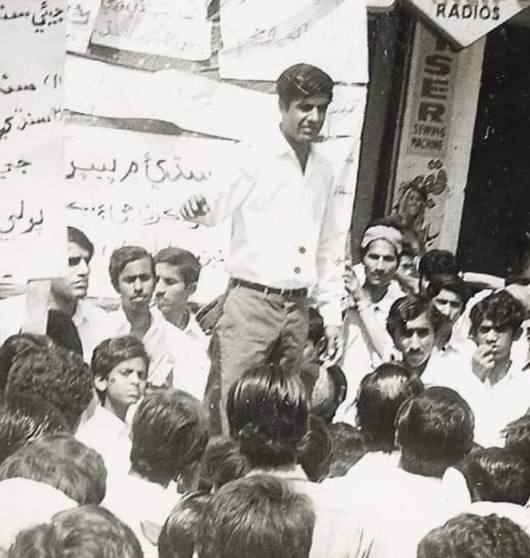
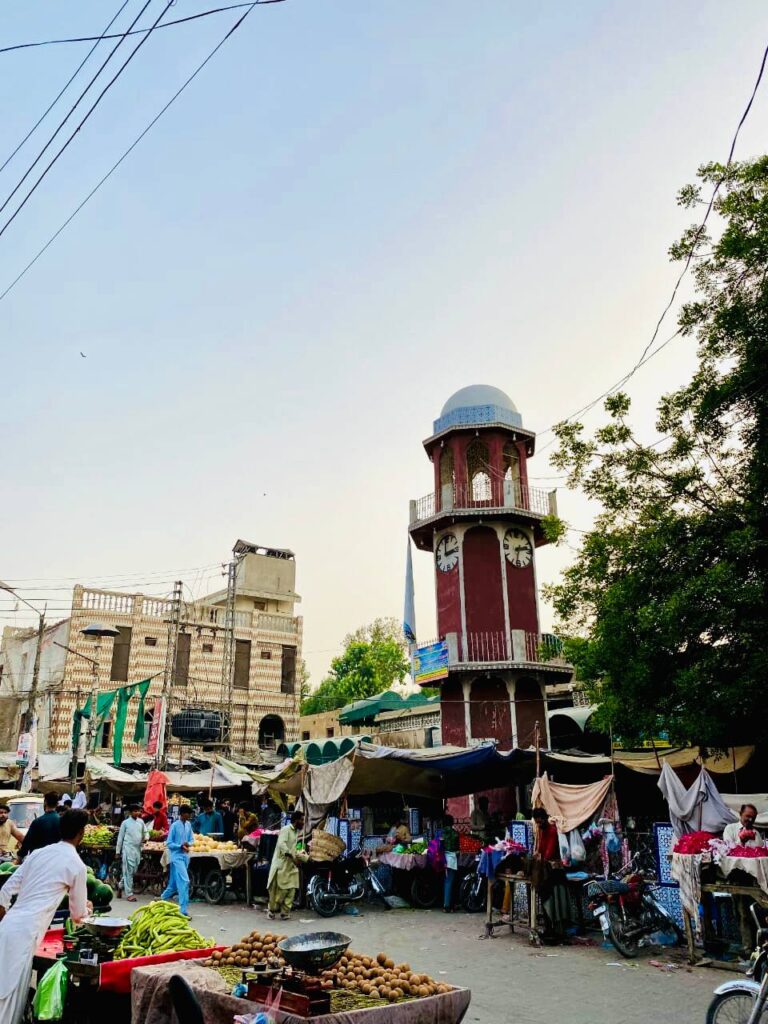
He is standing in the city’s Panj Golo, which literally translates to “five circles”, and is essentially the heart of the city centre. The reason they call it Panj Golo is because of the five roads which intersect at its center, creating a circle. This is where people from all walks of life can be found. It is the perfect spot to deliver a message. The men carry large signs and banners in Sindhi and the scene is that of an obvious protest or rally. Jiye Sindh, the posters say. Long live Sindh. Sindhi maa paper khareedo. Buy your papers in Sindhi. The slogans point to the purpose of the protest; it is against the controversial One Unit Scheme imposed by Prime Minister Muhammad Ali Bogra on November Twenty-second 1954.
In essence, the One Unit Scheme was a political measure taken by the central government which merged the four provinces of Pakistan, namely Sindh, Punjab, Khyber Pakhtunkhwa and Balochistan, into one single polity, West Pakistan, in order to parallel the province of East Pakistan or present-day Bangladesh. The Scheme also ruled that Urdu should be given primary status as the national language. The Pakistani government claimed that all this was for administerial ease, since the East and West were separated from each other by over a thousand miles. But in reality, it was a post-colonial colonial technique which suppressed regional voices and established a homogenized national identity. On that day of 22nd November, Bogra had announced: “There will be no Bengalis, no Punjabis, no Sindhis, no Pathans, no Balochis, no Bahawalpuris, no Khairpuris. The disappearance of these groups will strengthen the integrity of Pakistan.”
As a result of his love for reading and politics, Bashir felt that what this scheme was really doing was threatening the sanctity of the Sindhi nation. His political tutor, Ustad Ali Ahmed Dogar, had brought his attention to the situation, introducing the concept of nationalism and how it was unjust of the Pakistani government to reduce the status of the Sindhi language. Bashir could see the wisdom in his words, he had read enough political essays in his favourite Sohni Risala to know that what was happening was not right. His beloved Sindh was being stripped of its distinct identity.
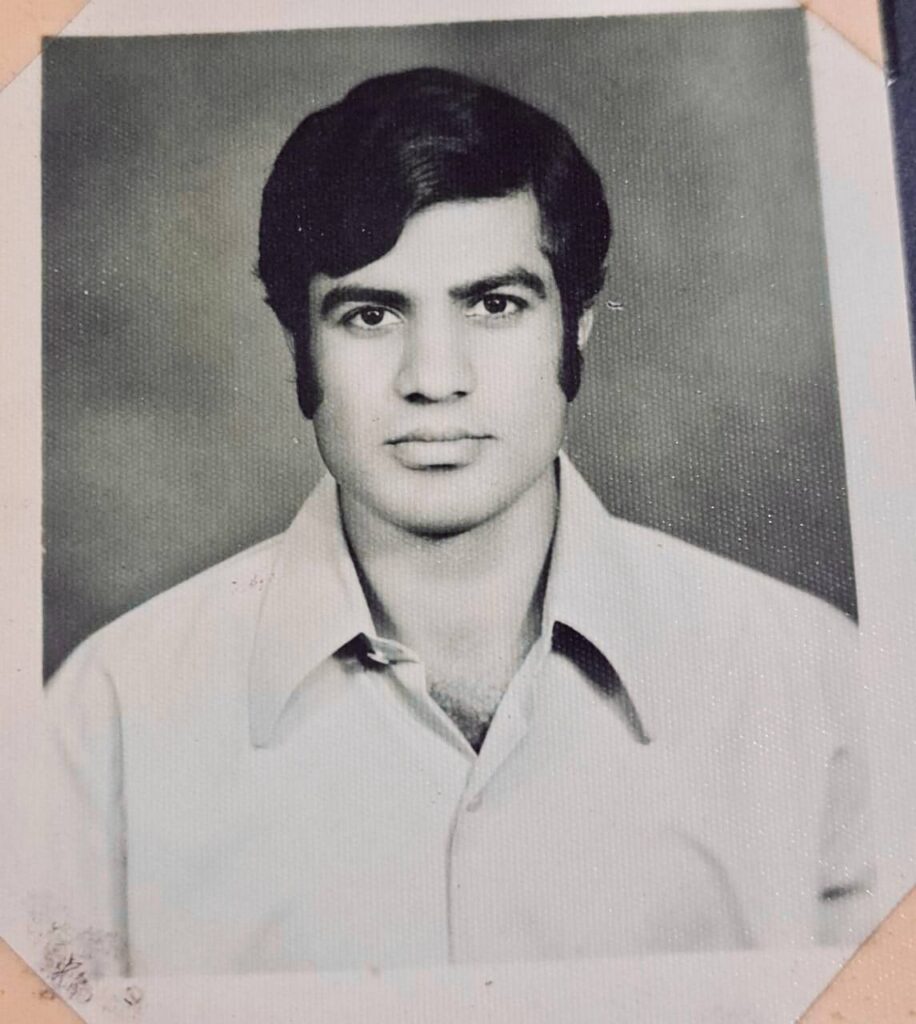
Just a few days before the protest, he had gathered with his peers from college and beyond in a small, crowded room to hold a student union meeting. This was a time in Pakistani history when student unions were not only legal, but also common and abundant. Bashir, too, was a part of this network. He was not only a member of G.M. Syed’s Jiay Sindh Students Federation (JSSF), which advocated for Sindhi students’ rights and endorsed an independent state of Sindhudesh, but also held a leadership position. He proudly tells me how he quickly rose to the position of JSSF Vice President in Khairpur, which included all colleges in the city. His leadership skills were excellent; he was able to mobilize a great number of people in very limited time. The meeting was held to plan the rally: who would speak, what they would say, what the demands would be, what the agenda was, and what the repercussions of such a wide-scale demonstration could be for student leaders.
Bashir did not care about the latter. He was prepared to make any sacrifice for the cause, be it jail, violence or suspension. He did not even bother to change out of his uniform; as soon as the final bell rang, he had run for the protest. And now he was here, standing before his fellow Sindhi people, asking for their support in refuting the One Unit Scheme and restoring Sindh’s provincial autonomy. He felt invincible in that moment, adrenaline coursing through his veins. There was so much he needed to say, and he would make it count. In his speech, he argued that even in colonial times, everything had been operated in Sindhi. Whether it was examinations, official letters or news telecasts; all of it was conducted in Sindhi. Not even imperial rule had been able to diminish and take away their language from them. How could they let it happen now?
On 1st July 1970, the initiative was dissolved by Yahya Khan. In 1972, the Sindh Assembly passed the Sindhi Language Bill under Mumtaz Bhutto. This Bill made Sindhi a compulsory subject in all schools in Sindh, whether public or private, and it continues to exist today, though not always implemented. No other province has such a legislation.
Looking back on this incident now, my grandfather tells me that he no longer identifies with some of the things he was fighting for then. Primarily, he is no longer a staunch separatist. He does not advocate for a separate Sindhi state. He left JSSF not long after this movement and joined the progressive left, marking the start of his journey with socialism. But he is still a Sindhi nationalist. This only leaves me with questions. What made him change his mind? And what is the difference between his nationalism and that of JSSF? What makes them all “nationalists”?
There is an interesting link between ethnicity and nationalism, which does not get talked about often. The idea that Sindh is a nation, is a concept that you cannot immediately grasp if you have been taught about the nation-state system growing up. This is because the modern nation-state system is shaped by colonial history and international law. It links political sovereignty with territorial boundaries. So the line between what really makes a nation a nation is quite blurry. It is difficult to place whether it has to do with geography, religion, culture, or something entirely different.
Dr. Saeed Ahmed Rid, a renowned Pakistani scholar, Bashir’s son and my father, talks about there being a psychological aspect to nationalism. What gives a nation its nationhood is not necessarily the fact that it has separate borders or autonomy, but a collective identity consisting of people who share something in common and believe that due to this commonality, they form a nation. The first step to becoming a nation, therefore, is believing you are one. Everything else follows afterwards. So, in that sense, nationalism on ethnic grounds becomes entirely possible. But then why do some nationalist movements such as Sindh and Balochistan still feel compelled to strive for geographic liberation?
Well, when a government is restrictive when it comes to religious and cultural pluralism, it limits the space for diverse identities to coexist. By imposing one collective singular identity upon its citizens, it causes tension and forces communities to adhere to an identity they do not feel fully reflects them. As a consequence, these communities feel they have to escape the realm of the state altogether in order to simply exist on their own terms. And as history has shown, attempts to erase or suppress identities only fuels movements for resistance. We see this in Bangladesh’s eventual secession in 1971. The forced disappearance of ethnic and regional identities does not strengthen national integrity. Instead, it weakens the social fabric and deepens divisions within the state.
Therefore, the reason groups like JSSF often seek independent borders is practical: self-governance, control over resources, and protection of their identity from assimilation or marginalization.
Bashir no longer identifies with the Sindhi separatist movement, but he is still a nationalist. Some might call him a traitor, because they feel the two are mutually exclusive. How can you be a nationalist and want Sindh to remain a part of Pakistan? The problem with separatist-nationalism, according to him, is that it is not a just system. “The Nationalist system is a betrayal,” he says. “It’s not in the benefit of the common man. If we acquired an independent state of Sindhudesh, we would be ruled over by the landlords – the waderay – and they do not take into account the issues of the ordinary people.” JSSF is a form of extreme Sindhi nationalism which is of the view that nobody can have any claim on Sindhi land except Sindhis and thus, only Sindhis can rule Sindh. Bashir vehemently opposes this idea and feels it is unjust.
In the end, he leaves me on this note, “It doesn’t matter what kind of tough government is ruling. Whether it’s martial law or dictator rule, it’s absolutely possible for the people to get what they want if they actively and passionately strive for it.” He is confident that if we keep striving and protesting, we can overturn the recent Six Canals Project introduced by the current Pakistani government under the Green Initiative. The project would be responsible for deepening inter-provincial water inequality, threatening Sindh’s ecology and livelihoods under the guise of development. And indeed, seeing the nation come together, putting aside their cultural and linguistic differences in opposition to this project makes me feel there is still some hope.