
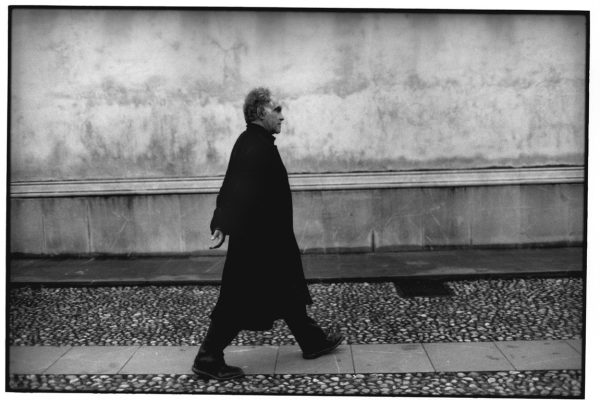
In late October of 2014, Magnus Bärtås, Andrej Slávik and Michelle Teran travelled to Bologna for a conversation with Carlo Ginzburg. Andrej had already met Carlo about a year before when he gave a guest lecture at Södertörn University, and seized the opportunity to tell him about the particulars of the Microhistories project, asking him if he would be interested in giving an interview.1
Indeed, he was. At the summit of a dizzying flight of stairs tucked behind massive front doors, Carlo welcomed us into an apartment where every available surface – shelves, tables, even chairs – was piled high with books, journals and assorted papers. After the introductions and niceties, we settled down in the innermost study and started out on what was to become a long and winding dialogue that lasted for most of the day (with a break for lunch) and reached into the next morning, touching on a broad range of sometimes unexpected topics.
This interview was first published in twelve parts, called snapshots, in between the articles of the book Microhistories2, publish in 2016 and edited by Bärtås and Slávik.
CG: So, I was in Pisa as a student, and the teaching technique employed there was unusual vis-à-vis other Italian university seminars. They were seminars, let’s say, in the German style: sitting around a table, working on a text in a very… I mean, I was there as a beginner, in my first year, and after only a few weeks, a historian – Delio Cantimori, who later became a sort of mentor to me, although he was not my Doktorvater [doctoral advisor] in a formal sense – came and said: we are going to work on Jacob Burckhardt’s Weltgeschichtliche Betrach- tungen. There were something like twenty students around the table, and maybe two of them were able to read German. And so, Cantimori said that, well, we were going to compare different translations, different languages and so on. And so, we started. It was a one-week seminar, meeting every day for maybe three hours – and at the end of the week, we had read twenty lines. That was amazing for me.
So, the discovery of slow reading. Much later, I discovered the expression that “philology is the art of slow reading”. I came across that quote in an essay by Roman Jakobson, but it actually came from [Friedrich] Nietzsche – from his inaugural lecture in Basel, when he was still a philologist. Philology as the art of slow reading: this was amazing, a real discovery, like entering a new world. But at that point, I had already read in translation [Erich] Auerbach’s Mimesis, which is based on that technique. In other words, picking up a segment, a fraction of a text, and then reading that small segment in a very intensive way. Retrospectively, I can see how I came to microhistory with this kind of drive. Microhistory has been a joint project, and everybody involved in it had a different background, more or less. I mean, all of them were historians, but with slightly different backgrounds. Then again, there are some striking convergences as well…
MB: Can I ask you about Auerbach’s work, because it is interesting – in terms of memory as well… If I am not mistaken, he wrote that book when he was in exile in Istanbul. And for us today, it is very difficult to understand how he could write something like that without access to all the relevant literature. You would think that he would have had his library, for example.
CG: Yes, that is a very good point. Actually, he made a remark about this when he said: “in this book, I have been unable to use secondary literature” – although he was able to use primary literature, in other words, the texts of Dante and so forth. That is why you do not have, let’s say, detailed footnotes in the book.
But there is an anecdote, something that I learned from a piece by Auerbach himself. He was in Istanbul and wanted to work on [Jacques-Paul] Migne’s Patrologia Latina, the huge collection of ecclesiastical writings, hundreds of thick volumes. In a major European library, you would have it – but in Istanbul, that collection of texts was only available, I think, in a Franciscan convent. So, Auerbach met the nuncio[papal envoy], Cardinal [Angelo Giuseppe] Roncalli, who later on became Pope John XXIII – an extraordinary meeting! – and asked him: “Would I be able to work here?” And he said yes. Actually, I think there must be a copy of Auerbach’s Mimesis in German with a hand-written dedication to Roncalli. Maybe it is in the Vatican Library? For some reason, I never checked.
AS: So, would you describe yourself primarily as a historian or a philologist?
CG: Good question. Philology in the sense of Giambattista Vico is a very comprehensive word. There is also a more technical meaning of philology, which could not include most of my work – but in the vichian sense, maybe I am an aspiring philologist. Otherwise, professionally, certainly a historian. But again, history… And then, there is the relation between historical writing and an antiquarian perspective – so if we assume that history in a contemporary sense implies antiquarianism as well, I would say yes, a historian. But with history taken as a kind of starting point: not as a fortress, but as an airport. You may proceed from there in different directions.
[ … ]
MB: We are also very curious about Bologna – the political climate at the time, the tensions. This was when you started to work actively with the term microhistory, right?
CG: Well, in a sense. I came to Bologna in 1970, and the moment of turmoil was in 1977. And certainly, there is an essay of mine which was published before the emergence of microhistory as a label, or more or less at the same time: “Clues”.[3]
In fact, this essay was first given as a seminar. When I started teaching – and this was Cantimori’s lesson, in a sense – I said, okay, what I will do is share an unfinished project with the students, a project that I am currently working on. Actually, together with Adriano Prosperi, a fellow historian and a good friend, I published a book called Giochi di pazienza – “puzzles” – which was also based on a seminar: the subtitle reads “A Seminar on ‘The Benefit of Christ’s Death’ ”.[4] It has never been translated into any language, and at one point we said to each other that it is probably unreadable – because the idea was to give a sort of unclean, unsanitised version of what a piece of research is, describing all the mistakes in detail: false routes, assumptions, biases, disprovals, and so on. And actually, when you get to the end, the last sentence is: Cominciammo a scrivere. “We started to write.” So, the book is about what we actually did. We also published a more conventional essay about the same 16th-century text, but the book was something else. It was about the prehistory of writing – the discussion with the students, and so on.
MB: How was that textually manifested in the book? Through transcriptions of your conversations, or…
CG: No, there were no tapes, no notes. We worked together, Adriano and myself… It’s not a detailed record of what took place in the class, but rather a retrospective description of what we did, emphasising the fact that when one starts with a hypothesis – which is a necessary starting point – there are a lot of biases. I have been working more recently on this connection between biases and hypotheses: I gave a lecture in Zurich about this, which will be published soon.[5] So, anyway, I cannot claim that it is a faithful account. Rather, it is a sort of self-reflection which tries to unveil, let’s say, some aspects of historical work that are usually not shared with the readers simply because only the final result is important – or supposed to be important. I think that we had just one review in Revue d’histoire ecclésiastique, which was extremely critical – and that was it! [laughter] But then, more recently, there was a journal – I think it was called Sixteenth Century Studies – that made a kind of referendum among scholars in the field on which, according to you, were the best books – and actually, I think a couple of historians mentioned this untranslatable book.
MB: It sounds very contemporary in a sense, the way that you try to create some kind of transparency regarding the process and also leave these things in the text: the mistakes, the ambiguity and all of that.
CG: What is behind it is the 20th century avant-garde, that’s for sure. You would have to ask Adriano Prosperi – but as far as I am concerned, I would say Berthold Brecht. The idea of showing the scaffolding, of delivering the text in quotation marks, so to speak – and actually acting or working against emotional identification, which I think is an extremely interesting element. I think that I have been very much under the impact of this.
And then, I would say [Marcel] Proust. I recently published a piece about my reading of Proust: I was invited to a seminar at the Collège de France led by Antoine Compagnon, which was called “Lecteur de Proust”.[6] There was a personal element there because my mother translated the first volume of À la recherche [du temps perdu]. So, I spoke about myself as a reader and the ways that Proust has had an impact on my own work – and one way was the idea of le roman du roman, of reflecting on one’s work as a part of the work. This is the 20th century avant-garde element, which is also evident – well, maybe not evident, but it is there as well – in my book The Cheese and the Worms, because it also has a sort of self-reflective aspect.[7]
AS: So, the microhistorical method transposed into the field of contemporary history, in a way?
CG: Yes, although… I mean, “the microhistorical method” – one could also say that, well, this is the historical method. You know…
AS: … or the philological method?
CG: Allora, “microhistory” – what does this mean? There is a possible misunderstanding where “micro” is related to the real or symbolic scale of the object.[8] This is not where I would place the emphasis. For me, “micro” relates to “microscope”.[9] In other words, an intensive approach to any topic – and then, there is the tricky element, that is, generalisation. So, it is not the individual case per se that is important, but rather how you can extract something larger from it. This is really difficult, and there are no blueprints for it.
I remember being invited years ago to Cambridge, England, to speak about microhistory, and I started out by saying: “Microhistory is about generalisation!” An unexpected point, to a certain extent – but I really believe this. Generalisation is an under-theorised aspect of the historian’s practice. So, if we assume that generalisation is something which cannot be taken for granted, which is different from case to case, then we have to reflect upon it.
MB: Can I ask how you conceive of that process? Where does generalisation come in? If an idea about a generalisation is already there from the beginning, that would be very much like a hypothesis. Or is generalisation—the moment when the general is extracted from the micro level—something that comes late in the working process?
CG: I would say that there is generalisation at every level. Actually, I once made a similar point about the narrative dimension of history: even the hypothesis is presented by way of narrative, in a narrative shape. You may say the same about generalisation. In other words, as you said, the hypothesis is a sort of general aspect – but then it is related to a specific case. So, there is an interaction: the hypothesis can be disproven. And so we have to start again, looking for another generalisation. Then, in the end, or nearly at the end, we can start out with new generalisations about – what? Questions, answers? Who knows? [laughs] This is what I meant when I said that it is an under-theorised aspect.
Now, I think that, basically, this is what microhistory is about: working on case studies and trying to build up more convincing, more fruitful generalisations. The notion of case studies can be regarded as more or less synonymous with microhistory – more or less. Some years ago, a collection of essays was published in French by Jacques Revel and [Jean Claude] Passeron, a pupil of [Pierre] Bourdieu: Penser par cas, “Thinking by cases”.[10] And actually, at a certain moment, they mentioned my piece on clues as something that was headed in that direction. I have already mentioned Auerbach’s Mimesis, which, certainly, I read as a book based on case studies. In the same vein, I would say that I also read – I was eighteen or so at the time – [Sigmund] Freud’s case studies in translation. One could say that every case is inexhaustible and, at the same time, related to some generalisation: this is really part of Freud’s approach, it seems to me. So, inexhaustible and deeply individual.
But what does it mean, an individual? This is something that seems obvious to me: that the individual is the point of intersection of multiple sets. Starting with myself, one could say that I am a member of a specific animal species, then of the male moiety, then of another set which is more circumscribed – let’s say, retired Italian professors – and so on. And then there is one set in which there is just one member, which is related to my fingerprints. Then again, the idea that an individual is related to his or her fingerprints, period, only makes sense to a policeman. But otherwise, there is this interaction between individual and less individual elements – and the result is what we typically call an individual, which is largely not individual. Let’s say, what is individual is the interaction… Okay, this is obvious, perhaps.
[ … ]
MT: Could I ask you a question? Going back to the notion of generalisation, of approaching a problem with a certain hypothesis – but looking at the particular, at specific cases… Then why would you choose one case over another? Why this case and not that?
CG: This is absolutely crucial. Naturally, you may say: “This is promising!” I was concerned with this question in my teaching, because the point is precisely to teach students why a certain case looks promising. Again, I think there are no blueprints. Maybe, let’s say, the possible convergence of different kinds of evidence: this could provide a
sort of vague orientation. But sometimes, this is not the case. In other words, even though there is such convergence, the result is not particularly interesting.
MB: Isn’t there an element of desire as well?
CG: Yes, there is. In fact, we talked about this in Giochi di pazienza, using the same word: “desire”. And to me, the idea would be to control this: the metaphor that I used several times is “sterilising the instruments”. Because, on the one hand, without desire, without, let’s say, a hypothesis, and so on, research would never take place: we would be unable, literally unable, to discover anything. But at the same time, we have to bring this under control. Otherwise, if there were no element of disproval, our animal species would not have survived: driven by desire, we would have started to eat stones – and that’s it! So there is feedback. Now, this is not so obvious because, as we tried to show in our book about the seminar, there are subtle attempts, including unconscious attempts, to prove something against the evidence. My point is that you may go about this in very subtle ways. And so, the idea is to control this process. Actually, a piece of mine that will be published soon – the lecture that I gave in Zurich – is subtitled: “Double-blind experiments from a historical point of view”.
MT: In your essay “Microhistory: Two or Three Things that I Know About It”, you talk about the anomalous versus something that is familiar and identifiable.[11] Now, the way something becomes familiar or possible to identify is through repetition – so there is this tension between something that you cannot immediately put your finger on, something that is out of place and therefore stands out, and then something that is already part of a pattern. I was wondering if you could talk about that a bit more.
CG: Absolutely. I think that, actually, the anomalous cases are more promising – but some cases are more anomalous than others, to paraphrase Orwell. So, there is a kind of flair – I refrain from using the word intuition – but it’s something that you can teach. Anyway, it is certainly true that anomalous cases are cognitively more rewarding than normal cases.
But what does it mean, a normal case? Do they even exist? I have been told that, in fact, in the States, the average consumer lives in Columbus, Ohio – a place that I have no particular interest in, but still… [laughter] So there is this fiction of what is a normal consumer: somebody living in Columbus, Ohio. It’s like a joke. Perhaps one could say that even a so-called normal case would not seem very normal if we looked at it from a close distance.
MB: If we look at normality in that way, it becomes very strange.
CG: Yes, the notion of estrangement is something that I have also worked on: making things strange, making a normal case seem abnormal or anomalous.[12] So there are techniques – but it is also true that I can imagine, let’s say, twenty witch trials and, looking at them, say: “okay, let’s start from this one, this looks more promising.” Why? I have tried to work on this, in other words, to make explicit some of the elements that were driving my choices. In the case of the benandanti, I immediately realized that this was an extreme anomaly – because, in that case, even the inquisitors were unable to make sense of what the defendants were saying, something that I never came across before or later.[13] So that was extreme luck and also an extreme case. I must admit that I have a sort of propensity for extreme cases. In principle, the most difficult cases are the most promising.
AS: So we find that anomalous cases are basically everywhere, depending on how closely you look – but at the same time, generalisation is already at work on all kinds of levels. And, of course, that would even pertain to the whole notion of a “case”. The policeman would tell you that it is all about fingerprints. Then again, if we go back to “The Name and the Game” – another piece that you wrote in the 70s, also co-authored, but this time with Carlo Poni – we find that, in culture at large, the name serves as a kind of placeholder that tends to normalize what is actually an entire life’s course, full of different events and different circumstances, into a single thing that we think about as a personal identity or something like that.[14]
CG: I agree completely. Actually, my favourite example of this – I mean, of the fact that generalisation begins with language – is a chapter in Jonathan Swift’s Gulliver’s Travels: that island, maybe Laputa, where people do not trust words, so they carry objects around on their shoulders.[15] Instead of saying the word “table”, they show a table – that table! In other words, to speak about “table” or “a table” or “the table” is already using a generalisation. Then there are proper nouns, but that is another issue.
AS: At this point, I think that it would be interesting to go back to a detail from the essay that you wrote together with Carlo Poni. Actually, I am not even sure of how to translate it – I don’t remember what solution they chose in the English version – but in Italian, the term is scienza del vissuto. Whether “micro-history” or not, you speak of the kind of history that you would like to write as a scienza del vissuto. Did you borrow that term from someone? How would you translate it?
CG: I suspect that it was Carlo Poni’s suggestion, but I completely agreed with him. I’m not sure. In any case, what I like about this expression is that it has a kind of oxymoronic quality. On the one hand, there is science and so, implicitly, distanciation et cetera. On the other hand, le vécu – because, in a way, I think it is more obvious in French.
AS: And in fact, the essay was partly addressed to a French readership, right? It was about the relation between the French and Italian…
CG: Yes, you are right. We had this dialogue with the Annales group – and I remember that the idea was to turn the tables, in a way, saying…
MT: Sorry, what was the English translation of that?
CG: Probably “of lived experience” or something like that.
MT: The science of lived experience?
AS: … but that would already be spelling it out a little, right?
CG: Well, you’re right: one has to unfold the implications of this expression into English, otherwise it will not make sense. Il vissuto – in other words, something which is lived experience but still inarticulate, so to speak. This is the oxymoronic quality: a science, but the science of something that is inarticulate, in a way, because it is so close to experience. So there is a tension.
AS: Could literature also be a scienza del vissuto?
CG: Well, in a sense, in so far that, as I would say, there is a cognitive quality in literature. This is an idea that I find extremely challenging: my work in the last twenty years, maybe thirty… Let’s say, the idea of fighting the neo-sceptics, those who argued that there is no rigorous boundary between fictional narratives and historical narratives. Now, I think that this is wrong, it has bad consequences, it is untenable – but instead of saying “no, no”, I went with a different strategy. Actually, my model was a metaphor used by Antonio Gramsci in the notebooks that he wrote in prison, where he spoke about guerra di posizione and guerra di movimento. Talking about a revolution in Europe, he said that there is a “war of position” – think of the First World War – where you dig a trench, and you stay there, and then there is a “war of manoeuvre” in which you attack by going into the enemy’s field. He was using this as a metaphor for contemporary events, but I took it as a metaphor for different intellectual strategies.
So, for instance, against those neo-skeptics, my first move concerned rhetoric. They said: “History is rhetoric.” My counter-argument was: “Yes, but what kind of rhetoric?” Let’s look at two different traditions. On the one hand, Aristotle’s rhetoric which implied proofs – so the lineage from Aristotle, via Quintilian, to [Lorenzo] Valla. On the other hand, Nietzsche’s anti-Aristotelian rhetoric, and then [Michel] Foucault and his epigons: Foucault was already an epigon – of Nietzsche – and then there are epigons of the epigon. That is the real bifurcation. In other words, the idea of, let’s say, counteracting the enemy and using his weapons against him. So much for rhetoric. And then, in a more general sense, maybe literature – saying, okay, you are focusing on literature, claiming that “everything is literature” and so on, implying that everything is fiction. This is very much a Nietzschean argument, in line with his early piece, On Truth and Lies in a Nonmoral Sense. And then I would say, okay, there has been a struggle between fiction and history over how to know and represent reality. In other words, there have been interchanges: I focused very much on the interchanges, talking about, let’s say, Stendhal’s challenge to historians, Balzac claiming to be “the historian of the 19th century” – and so on and so forth. Following the migration and the reuse of different devices that have a cognitive potential seems crucial to me. This is why I insisted against those neo-skeptics who said… Actually, they were following [Benedetto] Croce: there is a youthful essay by Croce – La storia ridotta sotto il concetto generale dell’arte, “History reduced under the general concept of art” – in which he said, well, let’s focus on the final product, the final outcome of history, as a literary work. My argument was sort of an ultra-radical argument, saying, okay, but why should we focus only on the final product? We have to look at the procedure and the trajectory as well. And if we do, we will find that there is narration at every stage – but also the possibility of testing your statement. Against the narrative argument of the neo-skeptics, one could say, there is my own “hyper-narrative” argument.
[ … ]
MB: But at the beginning of your career, I guess that the idea of the historian as a writer was not entirely accepted.
CG: It was not – and actually, I still remember the incredible excitement I felt when I wrote the first sentence of what became my first book, I benandanti: “So, after all, you can do this!” [laughs] In fact, one of my teachers in Pisa, Arsenio Frugoni, had written an extremely challenging book a couple of years before. He was a medievalist, and the book was about a 12th century heretic named Arnaldo da Brescia – we know very little about this man – with each chapter relating to a different source, usually a narrative source. The idea is to look at this man, this heretic, as if in a prism: you look at Arnaldo from the point of view of this or that piece of evidence, trying to reconstruct what the evidence says in terms of biases, literary models, and so on. So you have, let’s say, five Arnaldi, five different portraits. And then, there is an introduction in which Frugoni puts on a sort of sarcastic, dismissive attitude vis-à-vis the naïve, positivist assumption that there is a sort of epi-convergence between different kinds of evidence. In Pisa, I attended the seminar with him and was very impressed. Later on, I read the book and, actually, I was unable to ask him something that I would have liked to ask him – he died unexpectedly in a car accident – but I am pretty sure about the answer: what inspired him to write that kind of book was [Akira] Kurosawa’s Rashōmon. It is the Rashomon technique, but without the skeptical implications. In fact, this is not the case with Kurosawa either, but…
Anyway, the book was published in 1954.[16] I succeeded in having it translated into French, drawing attention to the extreme novelty of Frugoni’s approach. The point was to have – I think there is a similar metaphor in the introduction – a sculpture with a lot of additions, later additions. By removing the additions, you would produce a torso that was mutilated, but more genuine. Actually, I mentioned Frugoni in the introduction of a book of mine, saying that at that moment – let’s say, in the late 50s or early 60s – he was the only one addressing the issue of historical writing as such, even if only indirectly.[17] I remember that my first seminar with him was about Machiavelli’s Prince. So, it was not directly about writing, but writing was a part of it.
AS: I imagine that, considering your family background – both your parents were writers, and your mother went on to become, I believe, one of the most celebrated writers of post-war literature in Italy… With such an intimate acquaintance with literature from an early age, for you, personally, it could hardly have come as a shock that historians write books. Of course, historians write books! While, at least in the theory of history, the position that you describe as “neo-skeptical” is actually entirely predicated on positivist assumptions: it starts out from a kind of expectation about history that history cannot fulfil, and then jumps to the exact opposite conclusion. In fact, the truth is somewhere in between.
CG: Yes, in between – although I always remember Arnold Schoenberg’s motto: “All roads lead to Rome, except the middle road.” [laughs] No, I am joking, I am joking… Yes, there is something in the middle, but it is, let’s say, unpredictable, a sort of tortuous road.
AS: Not a golden mean, but…
CG: Exactly, exactly. I think what I felt as I wrote that first sentence was that even writing cannot be taken for granted. In other words, there are always several possibilities. Again, this is the avant-garde element: Proust. Or [Raymond] Queneau – rediscovering, through Queneau, something that is basically avant-garde. But then again… I mean, think of, let’s say, [Leo] Tolstoy. Or think of the incredible experiments made by [Fyodor] Dostoyevsky, which I have unfortunately only read in translation: for instance, the idea of a narrator who is unable to fully understand what is going on and what he is telling. On that level, I believe that there are incredible possibilities. I have been deeply influenced by literature, that’s for sure. By the movies as well – although later on, I lost interest in cinema.
[ … ]
CG: Somebody recently asked me to name a historian whom I am in constant dialogue with, and I answered: Marc Bloch. One could say, “Bloch died a long time ago!” – but I still have countless questions. Obviously, I sometimes read more recent works, but this kind of intensive dialogue… If I were to single out – I was about to use a non-Foucauldian word, “author”, but let’s say writers– two writers in the humanities whom I am constantly having a dialogue with, I would say Marc Bloch and Erich Auerbach.
AS: Your elective affinities?
CG: Elective… [sighs] I don’t know. Certainly, I was impressed by their work very early in my trajectory, when I was still under twenty. But I am surprised that I have always been able, it seems to me, to ask them new questions – or maybe they were asking the questions and I was trying to answer? And then, although perhaps to a lesser extent, Aby Warburg. I have been working recently on Warburg, and there is certainly an enormous challenge in his work. So, in a way, I selected a couple of interlocutors – and then I found a topic which had a lot of implications. All of this took place very early on. I think that, unconsciously, in order to counteract the risks involved in this – I mean, a sort of early fixation – I went on and on and kept changing topics. It is a sort of counter-poison: working on a wide range of topics, trying to learn again and again, always starting over from scratch – more or less. This is something that went on and on, and I am still involved in it. Of course, sometimes I go back and try to reflect on the implications of my choices, my work, and so on, but most of the time I am working on new topics. As I said, it is a kind of counter-poison. Because otherwise, it would have been the same obsession over and over. So, the idea is to be challenged on different grounds, to look at different disciplines, and… I am not saying that it was planned, but it worked that way. And certainly, the idea of learning from people who are doing something different is very strong – or of being challenged by a document that I came across by chance: what can I do with this? In one case, I waited maybe ten years or even more before working on that document, which seemed to be so promising.
[ … ]
AS: Is this why you became a historian rather than a writer of fiction? Because you considered that for a while when you were young…
CG: Yes, but as a child. Then I dreamt about becoming a painter and started to paint for some years – but I was no good, to put it simply. Well, I was tempteded… When I began my university studies in Pisa, I was deeply attracted by linguistics, but even earlier by art history. However, I was disappointed by the local art historian, so I did not become one myself – but I am still working on visual evidence. Actually, in the latest book that I published, the running thread is political iconography and also Aby Warburg’s notion of Pathosformeln.[18] It is about five artefacts; where the most recent one being Picasso’s Guernica. And then, going backwards, there is an essay on that poster of Lord [Herbert] Kitchener with his moustache, looking at you and pointing his finger: “Your country needs you!” It has been parodied as well. Then there is [Jacques-Louis] David’s Death of Marat, and then [Thomas] Hobbes, the frontispiece of Leviathan – and then the first essay, which is on a gilded vase with American scenes from the early 16th century. An incredible object! I remember I was walking through the Kunstkammer in Munich with my wife… It is incredible how many things one can see in a fraction of a second. I spent one year working on this object, which is really incredible. So, I am still dealing with visual evidence.
AS: So, from the very beginning, you have surrounded yourself with words, on the one hand, and images on the other hand.
CG: Yes – and then, there is the really challenging relationship between these two worlds. This is something that I am still working on. Actually, I have an unpublished piece on ekphrasis, a genre that began in ancient Greece: descriptions of artworks and other objects, either real ones or, more often, imagined ones. The shield of Achilles in the Iliad is the earliest example. My essay is about the cognitive implications of this device: to describe a painting or a drawing. I am fascinated by translation as a phenomenon, and I like to say that translation is the most powerful argument against extreme relativism. Because translation is possible, but it always limps. [laughs] There is no mirror correspondence; there is always a gap – the inadequacy of all translations, in a sense. Still, translation is possible: you can translate from one language into another and also, perhaps, from words into images, from images into words. But it is a sort of challenge.
[ … ]
AS: Going back to your early experiences of literature and your early sources of inspiration, I am especially curious about your relation to Italo Calvino, who worked with your mother in the Einaudi publishing house. I recently came across a story that I was not aware of before: that, sometime toward the end of the 60s, you were even involved with Calvino in some kind of project for a new journal?
CG: Yes, there is a book about this project – I think it’s over here…1 [reach- es towards the bookshelf]
AS: Yes, this is what I was not able to find in any Swedish library. And the whole idea came to nothing: there never was a journal.
CG: Italo Calvino was a close friend of my mother, so I remember him from my childhood. He was younger than my mother but they worked together, they were very close. Then, the two of us became friends, despite the age difference. And so, at one point, he set out on a project with Gianni Celati, another friend who was also much younger than him but who had already published a novel. They had the idea of starting a review called Alì Babà – although, actually, I do not recall that name… Anyway, that was the project. And then, there was this idea of staging a dialogue with Foucault, with… [hesitates] I remember having conversations, here in Bologna, with Calvino and Celati. Also, there was a very interesting philosopher who died years ago, [Enzo] Melandri, who wrote a book about analogy.
Now, when my essay on clues was eventually published, it was reviewed by Calvino – he was very much interested in that essay – and Celati once wrote that the essay, in a way, was indirectly connected to our exchanges about the journal, which is a possibility. Certainly, in a more direct way, when I started working on The Cheese and the Worms just a few years later, I remember having this idea of reading Queneau’s Exercises de style. I think it came from Celati, although Calvino had already translated – and this is a fantastic translation – Les fleurs bleues. This is really his masterpiece, Calvino’s translation of Queneau! And actually, Calvino became very close with Queneau and the Oulipo group when he was in Paris.
So, when I started to write The Cheese and the Worms… You see, I had come across the document related to Menocchio and the two trials a long time before, when I was working on the benandanti. I remember coming across a hand-written catalogue of the first thousand inquisitional trials in Udine which, actually, was itself produced by an inquisitor in the 18th century. This was before I was able to access the actual trials, because the ecclesiastical archive was closed and unavailable to scholars. It was by chance that I was able to find this volume in the Biblioteca Comunale in Udine, because it had been stolen from the archive a long time before and then purchased by the library. This was like a book of dreams – actually, it was about dreaming people… And so, I was looking through this list and stumbled over a reference to a peasant who said that the world had emerged della putredine, “out of putrefied matter”. I remember being extremely impressed and taking note of the number assigned to the trials in the catalogue. Then, seven years went by before I came to think about this reference and checked the trials again – because, in the meantime, I had been able to work in the ecclesiastical archive, and so on.
And then, when I started to write, I thought that maybe I would make an experiment like Queneau’s Exercises de style, with each paragraph in a different style: one as a parody of some kind of history, another as… I do not know whether I started, because then I told myself: “That’s frivolous, no, I can’t do that!” It would have been unethical, so I forgot about it – although I think that some of that is still there in the book, the idea of having those sections with clear-cut or sudden transitions. For instance, there is a paragraph called “Dialogue” in which there are only questions and answers, no commentary.
So, this is an echo of Queneau, in a way… But, even more directly, I think that it is an echo of a book that I read as a kid – I was eleven or so – and, in a sense, I was unable to understand what the book was about, because it was talking about movies that I had not seen: that is, [Sergei] Eisenstein’s book on film as a form, his theoretical writings, which had been translated by Einaudi. I mean, my mother was bringing home books published by them, so I read all kinds of things… The idea of montage emerged slowly, I think, from that early reading. Then from seeing Eisenstein’s films, of course – and then from reading the powerful, splendid essay on montage, on Dickens, Griffith, and so on. I believe that this is something that marked me deeply. Last month, we visited Riga and were able to see the incredible art nouveau façade built by Eisenstein’s father [Mikhail]. This is very important for understanding some aspects of Eisenstein’s visual style. I am thinking especially about the scene in Ivan [the Terrible] where there is a sort of a twisted image and then, in the background, a kind of procession that goes on slowly, slowly… This, I think, is typical art nouveau, a response to the art nouveau style of his father.
AS: I would like to pick up from the reference that you made to Antonio Gramsci. This morning, you referred to his notion of a guerra di posizione and… Well, I was very surprised when I read the interview that you did with Maria Pallares-Burke – some fifteen years ago, perhaps – and towards the end, you referred to another, more famous dictum of Gramsci’s: the notion of a “pessimism of intelligence, optimism of will” – which, actually, is not Gramsci’s to begin with, it is [Romain] Rolland’s. Now, the reason why I was surprised was because I had already seen the same dictum applied to your work – or at least to microhistory – in a book by Florike Egmond and Peter Mason, I don’t know if you read it…
CG: Yes, I remember: The Mammoth and something…
AS: That’s right, The Mammoth and the Mouse. It is about microhistory and morphology, which is also the subtitle. And when I saw it there, I thought: “This isn’t Ginzburg at all!”
CG: It’s not?
AS: No! [laughs] At least, that was my reaction – but then I found it in the interview with Pallares-Burke, where it came directly from you. Well, you can imagine that I was a little disappointed. [laughs]
CG: But I mean, “from me”… What we have is a chain of quotations: first Romain Rolland, and then Gramsci reinterpreting Rolland, and then myself – like many other people – reinterpreting Gramsci. So, okay, what does it mean? First of all, we could put Gramsci’s quotation in context. Maybe he even used it before he was put in jail? – Yes, I suspect so. But certainly, we have to reinterpret that dictum in light of Gramsci’s own experience. There has been a major defeat: this was the context in which I thought about that motto. A major defeat – that is, fascism. And then, we have to fight anyway – but we also need to look at reality as it is, which is difficult. Today, I think that I would have rather mentioned another quotation that I used in a different context. It is from Walter Benjamin when he was playing chess with Brecht in Denmark – so, two exiles – and Brecht said: “We have to start, not from the good old things, but from the bad new things.”
I think that this is a magnificent motto! The context is more or less the same, if you think about: let’s say, Gramsci rethinking Rolland’s motto, possibly quoting it in a letter – I have to check… So, there has been a defeat, but we cannot hang on to the good old things. Looking at the past in that way does not make sense.
AS: Yes, but the reason why I was so surprised to find that reference in the interview is really… I mean, if you take Gramsci’s motto part for part, I can definitely see how this notion of a pessimism of intelligence goes along with your ambition of “painting from nature”, if you like – and I can also see how the optimism of the will fits with your insistence on the speculative element in historical knowledge, on the fact that knowledge is possible, that translation is possible, after all. So it does make sense – but still, taken as a whole, there is a crucial part missing. Because what you have here is, in effect, a sort of Kantian dualism – and what is missing is a kind of dynamic between these two poles, something that Kant himself discussed in his third critique on the “power of judgment”. To my mind, there are many things throughout your work that point in this intermediate direction. I mean, this entire idea, which you formulate early on, of finding some kind of passage between rationalism, on the one hand, and irrationalism, on the other hand… A way, if you like, of making the intellect and the will influence one another.
CG: I would say that I follow you completely, but there is a “but”. Yes, I think that a solution must be found – but not too quickly, not too early. It must be postponed as much as possible. So, the idea is to have a clash, a kind of “unsolvable solution” – and then we have to find a way. That is why I am fascinated by this tension between pessimism and optimism because it seems unsolvable. Again, you could say that this is a kind of avant-garde element. For instance, my emphasis on montage: what fascinates me about montage is the sudden transition – the juxtaposition, in this case – which obviously has cognitive elements. Then, a solution must be found – but as late as possible because a quick solution could easily become a compromise. What I love about contradiction is its explosive nature: it must be there, unsolvable, unsolvable, and then… let’s fight! This would be the optimism. But I think that, after all, the idea of a pessimism of intelligence – if we look at the world we live in, it is not so absurd.
AS: So there is good reason to be pessimistic – even if you are not in prison like Gramsci was.
CG: Exactly. So you can rephrase that motto, applying it to a different kind of reality. But it still works.
[ … ]
AS: I also think that your interest in a figure like Montaigne, or in a figure of thought such as the grotesque, can be related to this discussion about pessimism and optimism, about retaining the tension and at the same time striving for a solution. I mean, the grotesque is also… You have this combination of… It is a kind of balancing act, just like when Montaigne turns his attention to himself. He wants to paint according to nature, he does not want to embellish or leave anything out – but there is also an element of respect for the public. So he is not out to shock, he does not want to épater la bourgeoisie [scandalize the middle classes] or anything like that.
CG: Yes – but, first of all, the disjunction or juxtaposition: this is very much in Montaigne’s spirit, I would say. Actually, he makes reference to the art of marqueterie, a sort of mosaic of different pieces in different colors – just the opposite of a continuum. Against seamless integration, he stresses the transitions. To my mind, this is very much part of the essay as a form, which opens up the possibility of sudden transitions as well as of having a compression of different topics in a limited space. This is something that I suddenly discovered when I wrote that piece on clues.
I think that I have had different reasons for writing essays – also because there were, let’s say, pressures from outside. I could have been able to resist them, so perhaps they were not real pressures – but I was tempted to have a dialogue, like the one we are having here today. So, short essays, in response to being invited to such and such a place: this was a sort of social pressure, and one that I accepted. Especially because I try to work on different topics, every time if possible, starting out a new topic and then sharing it with a new audience. So there is this element of discontinuity in my work – it is a marqueterie mal jointe, a “badly joined inlay”, as Montaigne would say.
And then the grotesque, which I also referred to in my essay on Montaigne.[19] I think that there was a kind of coquetteriein this on Montaigne’s part. It is as if he was saying: “Some readers will be shocked by the fact that I am talking about myself, writing in this strange genre.” Actually, there were precedents, more or less… I think he mentioned one himself: the Noctes Atticae of Aulus Gellius. And then there is Pascal reacting to Montaigne, saying something like: quelle sote idée de parler de lui-même![20] That is to say, the idea of talking about oneself in this way was simply stupid. This is a fascinating remark because Pascal was literally obsessed by Montaigne: to him, Montaigne was a kind of devil’s advocate, that’s for sure. So there is this ambivalence at work here: Pascal is having an endless conversation with Montaigne, but at the same time, saying, “This is absurd; what is he doing?”.
As for myself, I have slowly been realising how crucial ambivalence is and how important it is to deal with it – because, psychologically, I have this tendency to see things in black and white as a first reaction. And then, again, trying to find a way. And then, there is a third problem, which is ambivalence as such. This is certainly something that I learned about from Freud.
MT: But this endless conversation is also driven by questions. This is an important aspect of the essay as well: that it is driven by questions while, perhaps, the answers are never arrived at – just an endless questioning.
CG: Yes, there is this questioning attitude, that is true. I think this is absolutely crucial for all aspects of Montaigne’s work.
[3] Carlo Ginzburg, “Clues: Roots of an Evidential Paradigm”, in Clues, Myths, and the Historical Method (Baltimore: Johns Hopkins University Press, 1989).
[4] Carlo Ginzburg & Adriano Prosperi, Giochi di pazienza. un seminario sul Beneficio di Cristo (Torino:
Einaudi, 1975). A more literal translation of the title would be “Games of Solitaire”.
[5] “Schema and Bias: A Historian’s Reflection on Double Blind Experiments”, October 27, 2011. A flyer
for the event is available for download on: https://www.collegium.ethz.ch/fileadmin/user_upload/ch_events/1110_flecklecture.pdf (accessed 2016–02–12).
[6] “L’étranger qui n’est pas de la maison”, March 19, 2013. A video recording of the lecture is available on:
http://www.college-de-france.fr/site/antoine-compagnon/
seminar-2013-03-19-17h30.htm.
It has subsequently been published under the same title in Antoine Compagnon (ed.), Lire et relire Proust (Nantes: Éditions nouvelles Cécile Defaut, 2014).
[7] Carlo Ginzburg, The Cheese and the Worms. The Cosmos of a Sixteenth-Century Miller (London: Routledge, 1980).
[8] That the object under study is ‘small’ in a literal or metaphorical – e.g. political – sense.
[9] In this sense, it is more related to the subject rather than the object – or, even more accurately, to the relation between subject and object, observer and observed.
[10] Jean-Claude Passeron & Jacques Revel (eds.), Penser par cas (Paris: Éditions de l’École des hautes études
en sciences sociales, 2005).
[11] Carlo Ginzburg, “Microhistory: Two or Three Things That I Know About It”, Critical Inquiry 20:1 (1993). Also published in Threads and Traces. True, False, Fictive (Berkeley: University of CaliforniaPress, 2012).
[12] Ginzburg is alluding to his essay “Making Things Strange: The Prehistory of a Literary Device”, Representations 56 (1996). Also published as “Making it Strange: The Prehistory of a Literary Device”, in
Wooden Eyes. Nine Reflections on Distance (London: Verso, 2002).
[13] Carlo Ginzburg, The Night Battles. Witchcraft and Agrarian Cults in the Sixteenth and Seventeenth Centuries
(Baltimore: Johns Hopkins University Press, 1983).
[14] Carlo Ginzburg and Carlo Poni, “The Name and the Game: Unequal Exchange in the Historiographic Marketplace”, in Edward Muir and Guido Ruggiero (eds.), Microhistory and the Lost Peoples of Europe (Baltimore: Johns Hopkins University Press, 1991).
[15] In fact, the episode takes place in Lagado, the capital of the island Balnibarbi – which, however, is
subject to the king of Laputa: see Gulliver’s Travels, part III, ch. 5
[16] i.e. four years after Kurosawa’s film, which appeared in 1950.
[17] Cf. Ginzburg, Threads and Traces, 1.
[18] Carlo Ginzburg, Paura, reverenza, terrore. Cinquesaggi di iconografia politica (Milano: Adelphi, 2015).
[19] Carlo Ginzburg, “Montaigne, Cannibals, and Grottoes”, History and Anthropology 6 (1993). Also published in Threads and Traces.
[20] Ginzburg is quoting freely and from memory. The actual passage reads: “Le sot projet qu’il a de se peindre […]” Blaise Pascal, Pensées, in Oeuvres complètes, vol. n, edited by Michel Le Guern (Paris: Gallimard, nn), … (no. 653).
- [1] “Inner Dialogues – The Jew as Devil’s Advocate”, November 6, 2013. The lecture was arranged as a joint venture by the research program Time, Memory and Representation, the research project Loss of Grounds as Common Ground and Södertörn’s Centre for Baltic and Eastern European Studies (CBEES). ↩︎
- [2] Bärtås, M., & Slávik, A (ed.). (2016). Microhistories. Stockholm: Konstfack ↩︎
